

Case descriptions for these cases will be published soon.
Cluster 5 - Robotics & High Tech

Robotic Decanting for Albert Heijn E-commerce: Automating the next generation of E-com Distribution centers
For Albert Heijn Online, products arrive in many forms and are manually decanted into the mechanized systems. Automating this is difficult due to the variety of packaging. Your goal is to develop a mechanized solution that overcomes this challenge and sets the stage for intelligent, scalable automation.


Critical Raw Materials from Medical Waste Streams
The project is embedded in a GreenCycl led medical-sector project, showcasing how circular material recovery and design for reusability, repairability, and recyclability can be translated into advanced magnet components.
The objective is to identify, quantify, recover, and redesign the use of critical raw materials from selected medical waste streams, with a focus on magnetic components used in medical devices.


(Un)wrapping the Future of Air Cargo
Every day, air cargo is wrapped in plastic and netting in order to make it safe to fly. This slows operations and limits automation possibilities. KLM Cargo invites TU Delft students to reinvent this process. Your challenge: create a smarter, more sustainable way to secure freight that works with automation instead of against it, while staying safe, compliant and scalable.


Radiation Detection and Decontamination Robot
A JIP 2025 prototype robot for nuclear medicine can detect radiation but still lacks reliable autonomous driving, source finding, localization and cleaning. The goal is to improve these aspects, so the robot can operate in a hospital environment. Ultimately, the robot should autonomously locate and support decontamination of radioactive spills, reducing radiation exposure for healthcare staff.


Space Architecture and Robotics
Constructing off-Earth habitats presents a multitude of interdisciplinary challenges requiring consideration to various aspects ranging from the extraction of raw materials to the production and assembly of inhabitable structures using autonomous robots. The ultimate goal is to address those challenges and develop an autarkic robotic system for constructing habitats.


Seabed Infratsructure Monitoring and Protection
Critical subsea pipelines and cables are vulnerable to sabotage and interference. The project should focus on solutions that detect nearby activity through changes in vibration, pressure, or temperature, provide continuous monitoring and alert operators in real time so authorities can act. Ultimately cost and reliability will detremine the preferred solution.


The future role of robotics in different markets
We have built quite some experience on the topic of robotics and its relevance for organizations acting in rail infrastructure. We are looking for efficient ways to leverage this knowledge to other markets within Haskoning. We would like to diminish reinventing the wheel by other markets and accelerate our go-to-market with valuable propositions for other segments/ target customers


Swarm Head; A bio-inspired sensor head for perception, primitive interaction, and autonomous decision-making in ROS-based robots
Swarm Head equips simple robots with perception, primitive interaction, and local decision-making. A modular sensor head allows robots to see, detect pests and plant diseases, and decide where to move next. Through simple signals and animal-like behavior, robots interact with their environment and each other, turning generic ROS robots into autonomous exploratory agents in living ecosystems.

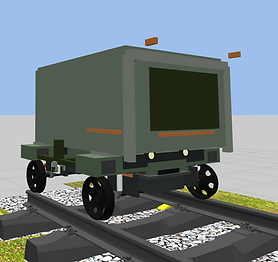
Robots on Rails: A Modular Robot for Railway Inspection
We will develop a physical prototype of a modular railway inspection robot to validate robotic inspection of rail infrastructure and explore its product-market fit in a regulated industry. The project combines mechanical design, sensor integration, robotic navigation, inspection-data processing, and business case validation. The robot will assist workers by performing inspection routes, collecting repeatable data, and detecting visible defects.


Scaling Up Foundation Concepts for Deep-Water Offshore Wind
Offshore wind is moving into deeper waters, where simply scaling current foundation concepts creates challenges in installation, practical feasibility, and underwater noise emissions. This project challenges students to develop out-of-the-box bottom-fixed foundation concepts for 70–100 m water depth that remain feasible at offshore scale and installable without exceeding underwater noise limits.


Dashboard Predictive Maintenance: for intensively operated cranes
Our clients of offshore cranes subscribe to recently developed Performance Insights Dashboards. The last provide overviews of the usage of cranes including the individual critical components. The dashboard information is converted into recommendations for inspection and maintenance. It also provides information on energy consumption. In addition to usage monitoring dashboards, Huisman is currently developing dashboards for Condition Based Monitoring (CBM).


Navigation technology for small sailing drones
The Dutch Navy is currently developing operational concepts in which smalll, low-cost unmanned surface vessels have important roles for different tasks, and operate independently. The technology requiered by such unmanned vessels for navigation is under scrutiny. In this JIP, the students are requested to design a system of sensors and software that can be used.

Swarm Field; Distributed swarm intelligence for exploration, mapping, and potential-field-based coordination of robotic agents
Swarm Field explores how multiple robots cooperate to map pest distribution and plant health. Using local interaction rules and potential fields, robots spread out, explore, and share information without central control. The swarm forms a dynamic, self-organizing sensor network that continuously updates environmental knowledge, enabling robust, scalable monitoring of crops through collective behavior and distributed intelligence.
